
Why Does My Dog Sniff Everything? The Science Behind Your Dog's Nose
Your dog stops to sniff everything because their sense of smell is their primary tool for understanding the world. While humans rely on vision for most of their environmental information, a dog's sense is centered on their extraordinary olfactory abilities. Imagine experiencing the world through a dog's sense of smell: dogs have up to 100 million scent receptors in their noses, and Bloodhounds can have as many as 300 million, compared to just 5–6 million in humans. Every sniff stop on a walk is your dog actively gathering data through their sense of smell, and supporting that behavior is one of the most practical things you can do for their daily well-being.
How a Dog's Nose Actually Works
When a dog sniffs, a specialized airflow pattern directs odor molecules toward the olfactory epithelium, where receptors bind to scent particles and send signals directly to the brain. Dogs also have a second scent organ called the vomeronasal (Jacobson's) organ, which is dedicated to detecting pheromones that communicate emotional states and reproductive status from other animals. This organ helps dogs identify and analyze complex odors, such as those from other dogs, cats, or even humans.
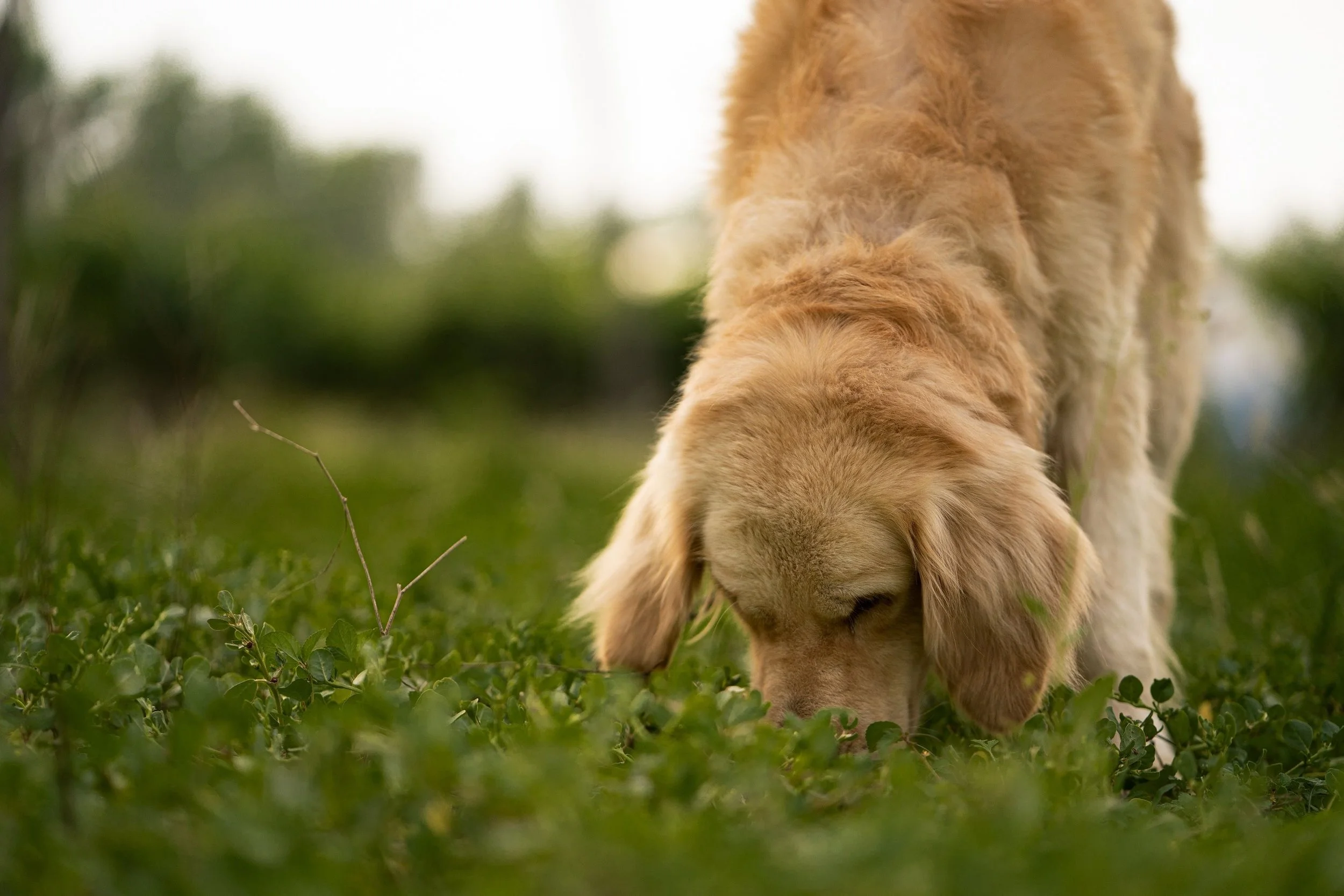
Their sense of smell is so advanced that they can detect some smells in parts per trillion, differentiating between complex odors and identifying individual ingredients in food, such as a hamburger. This dual system allows a single sniff to deliver layered, detailed information—enabling dogs to identify scents related to food, animals, and objects—that would take a human multiple sensory inputs to approximate.
What Your Dog Is Actually "Reading" on a Walk
Every surface your dog stops to sniff is like reading 'pee mail'—a scent record left by other animals, people, and environmental changes over time. In neighborhoods with many dogs, these scent marks act as a social bulletin board, communicating about territory, reproductive status, and social rank. Dogs can detect how recently another animal passed through an area; the sex and reproductive status of that animal; whether it was stressed or healthy; and much more, all from trace chemical compounds in urine, secretions, or even paw prints. Whether outside or inside the house, when dogs sniff things, they are gathering essential information and mentally stimulating themselves. A single sniff stop is the equivalent of your dog reading a detailed report on everything that has happened in that spot.
Why Dogs Sniff Other Dogs' Rear Ends
Of course, dogs use their sense of smell as their primary way to interpret and communicate in their environment, including smelling other dogs.
The area around a dog’s anal glands contains a concentrated source of individual chemical identifiers, including pheromones that communicate age, sex, health status, and emotional state. Sniffing this region is how dogs formally assess one another and confirm who they are dealing with. It is direct, efficient, and far more information-dense than anything a visual greeting could communicate.
Sniffing Is a Mental Health Tool, Not Just a Habit
Allowing your dog to sniff freely activates their brain’s seeking system, releases dopamine, and provides essential mental stimulation, producing a state of calm engagement rather than arousal or frustration. According to the Animal Humane Society, sniffing activates many parts of a dog’s brain, releases the pleasure hormone dopamine, and promotes rest. Research shows it can even measurably decrease a dog’s heart rate, which directly lowers anxiety and provides stress relief. Allowing your dog to sniff during walks is essential for their mental stimulation and well-being, helping them process complex scents, solve 'scent puzzles,' and enjoy the 'notes' of their environment—making the experience more enjoyable and fun for them. In fact, just fifteen to twenty minutes of intense sniffing can exhaust a dog as much as an hour-long run, showing that sniffing can be as tiring as physical exercise. This makes dedicated sniff time one of the most effective, fun, and lowest-effort forms of mental enrichment available to pet parents.
The Research on Sniffing and Behavioral Health
A 2024 study published in the journal Animals found that dogs engaged in regular scent work showed measurably improved inhibitory control, meaning they were better able to stay calm and respond rationally rather than react impulsively. Pet parents who incorporate intentional sniffing time into daily walks not only support their dogs' mental stimulation but also foster emotional well-being for their pets. Reduced access to sniffing, by contrast, is consistently associated with higher rates of boredom-driven behaviors including destructiveness and excessive vocalization. Experts recommend allowing 'sniffaris'—walks where the dog sets the pace and is free to follow their nose—to support overall emotional and behavioral health. Pet parents who build intentional sniff time into daily walks tend to see calmer, more settled behavior at home within a matter of weeks.
Should You Let Your Dog Sniff as Long as They Want?
Not necessarily, but leaning toward more sniff time is almost always better than less for a good walk. Occasionally, dogs may exhibit unique sniffing behaviors in response to new scents or changes in their environment, which is important to recognize. The goal is not to make every walk an open-ended sniff session, but to build in consistent sniff time where your dog can follow their nose without being pulled along. Consider your dog's age when planning activities—older or arthritic dogs may not be able to walk as far, but allowing them to sniff is essential for their mental well-being and lets them enjoy the 'notes' of their environment.
What a Sniff Walk Looks Like in Practice
A sniff walk means letting your dog lead the pace and choose where to pause, within safe limits, and taking time to encourage sniffing along the way. A longer leash gives your pup more freedom to explore without losing control of the situation. Varying your route regularly so your dog encounters new scent environments adds measurable enrichment value. You can also incorporate scent games, such as hiding treats for your pup to find, or using treats as rewards during sniff breaks to make walks more engaging and mentally stimulating.
When Sniffing Behavior Is Worth Watching
Most sniffing is healthy and expected, so there's usually no need to worry about your dog's curiosity. However, a sudden increase in compulsive ground sniffing, especially indoors or in areas with no obvious scent interest, can sometimes indicate anxiety, cognitive changes in senior dogs, or neurological issues. Dogs can even detect changes in your body, such as hormonal shifts, stress, fear, or illnesses like diabetes and cancer, by smelling chemical changes in your breath and sweat. If your dog is sniffing compulsively, seems unable to redirect, or is showing other behavioral shifts at the same time, it's important to consult a veterinarian to rule out underlying health issues or allergies. Catching cognitive or anxiety-related changes early gives you significantly more options for intervention and management.
FAQ
Is it okay to let my dog sniff strangers or other dogs?
Yes, in most cases. Sniffing is how dogs gather social information and assess whether an interaction feels safe. Allowing brief, controlled sniff greetings supports healthier social behavior and can reduce reactivity over time.
Why does my dog sniff the same spot over and over?
Repeated sniffing of one location usually means the scent record there is complex or layered. Multiple animals may have passed through, or a particularly compelling chemical signal is present. Your dog is processing all of it, one sniff at a time.
Does breed affect how much a dog sniffs?
Yes. Scent hounds like Beagles, Bloodhounds, and Basset Hounds were selectively bred for olfactory work and typically show more intense, sustained sniffing behavior. Brachycephalic breeds, those with shorter noses, have slightly reduced olfactory sensitivity compared to longer-snouted dogs.
Should I be concerned if my senior dog sniffs less than they used to?
A noticeable decline in sniffing interest in an older dog can be an early indicator of cognitive or sensory changes. If you observe this alongside disorientation, changes in sleep, or reduced engagement with their environment, flag it at your next vet visit. Early detection of cognitive decline expands your options for supporting quality of life.
How do I know if my dog is getting enough sniff time?
A dog with adequate sniff enrichment tends to be calmer and more settled after walks rather than restless or attention-seeking at home. If your dog consistently seems unsatisfied after exercise, increasing sniff time is a practical first step before assuming the issue is a lack of physical activity.
Your dog stops to sniff everything because their nose is doing exactly what it evolved to do, gathering information, regulating emotions, and engaging with the world in the most natural way available to them. Building consistent sniff time into your daily routine is one of the simplest, most evidence-backed investments you can make in your dog's mental health and behavioral stability. It costs nothing and delivers results you can observe within days.